.svg)
.svg)
Water Utility Data Migration: Why Implementations Stall—and How Utilities Can Reduce Risk
When water utilities evaluate new software, the conversation often starts with features.
Can it automate compliance reporting?
Will it improve operational visibility?
Can it integrate with existing systems?
Those are important questions. But according to Elaine Kelly, the moment that often determines whether a modernization project succeeds or struggles happens after the purchase decision has already been made.
It’s implementation.
In Klir’s recent webinar, The 24-Hour Data Migration: Redefining Implementation for Water Utilities, Elaine Kelly and Data Consultant Dani Tahir explored why software implementations so often fall behind schedule, what makes water utility data migration uniquely challenging, and how utilities can dramatically reduce implementation risk.
For utility leaders, operations managers, pretreatment coordinators, and CIOs evaluating modernization initiatives, the discussion highlighted an important reality:
Implementation is not simply a technical exercise. It’s the first step toward realizing value from any software investment.
Why Implementation Matters More Than Software Features
A new software platform cannot improve compliance, increase efficiency, or reduce operational risk until it is properly configured, adopted, and integrated into daily operations.
Implementation includes:
- Migrating historical data
- Configuring workflows
- Setting up monitoring programs
- Integrating systems
- Training users
- Establishing reporting processes
Until those activities are complete, utilities have not yet realized the value of their investment.
As Kelly explained during the webinar, implementation is often the first real partnership test between a utility and its software provider.
The quality of that experience can significantly influence user adoption, executive confidence, and long-term project success.
The Hidden Cost of Delayed Implementations
Research cited during the webinar found that approximately 67% of enterprise software implementations take longer than expected.
For water utilities, those delays can have real consequences.
Projects that extend beyond planned timelines often create:
- Increased operational disruption
- Additional internal resource requirements
- Delayed return on investment
- Reduced user confidence
- Executive skepticism toward future modernization initiatives
While software vendors frequently focus on functionality, utility leaders are increasingly evaluating implementation predictability as a critical component of vendor selection.
A platform may offer excellent capabilities, but if implementation creates months of disruption, the business case becomes more difficult to justify.
Why Water Utility Data Migration Is So Challenging
Unlike many industries, water utilities operate in highly complex data environments.
Operational, laboratory, compliance, and asset data often reside across multiple disconnected systems that have evolved over many years.
This complexity creates several common implementation challenges.
1. Data Formatting Inconsistencies
Many utilities manage data across:
- Legacy databases
- Excel spreadsheets
- Laboratory systems
- PDF records
- Shared drives
- Custom applications
Even when information is accurate, data structures frequently differ from system to system.
Before migration can occur, those datasets must be standardized and organized into formats that can be interpreted consistently.
2. Parameter Normalization
Water quality data presents another challenge.
The same parameter may appear in multiple forms:
- Ammonia
- NH3
- Ammonia-N
- NH3-N
While these may represent the same underlying measurement, software systems often interpret them differently.
Without normalization, reporting accuracy and compliance tracking can be compromised.
3. Unit Conversion Complexity
Utilities commonly manage measurements using different units.
For example:
- Milligrams per liter (mg/L)
- Micrograms per liter (µg/L)
Consolidating these datasets requires careful conversion and validation to ensure consistency across historical records and reporting outputs.
4. Identifying the Source of Truth
Many utilities maintain overlapping datasets across multiple systems.
A compliance manager may rely on one system.
A laboratory may use another.
Operations teams may maintain supplemental spreadsheets.
During migration, identifying the authoritative source of information becomes critical.
Without a clearly defined source of truth, conflicting records can introduce risk into reporting and operational decision-making.
5. Limited Internal Bandwidth
Perhaps the most significant challenge isn’t technical at all.
Utility staff are busy operating treatment plants, managing permits, responding to regulators, and maintaining infrastructure.
Most utility professionals are experts in water operations—not data engineering.
Yet traditional implementations often require customers to spend weeks or months:
- Cleaning data
- Formatting spreadsheets
- Mapping parameters
- Preparing imports
That additional workload can quickly slow project timelines.
Why Traditional Migration Approaches Create Risk
Historically, software vendors have often placed significant responsibility on the customer.
The process typically looks something like this:
- Utility identifies data.
- Utility cleanses data.
- Utility validates data.
- Vendor imports data.
The challenge is obvious.
The people being asked to perform this work are already managing full-time operational responsibilities.
As a result, projects become dependent on limited internal resources and competing priorities.
This creates delays, frustration, and uncertainty.
Rethinking the Data Migration Process
At Klir, the implementation team began asking a different question:
What if utilities didn’t need to become data migration experts?
Rather than requiring customers to standardize and cleanse data before migration begins, Klir’s implementation approach focuses on removing as much of that burden as possible from utility teams.
Instead of spending weeks preparing exports, utilities can provide data in its existing format.
Klir’s implementation specialists then handle the heavy lifting.
This shift changes the conversation from:
“Prepare your data and send it to us.”
to:
“Send us your data and we’ll help prepare it.”
For many utilities, that difference can significantly reduce implementation friction.
Inside Klir’s 24-Hour Data Migration Approach
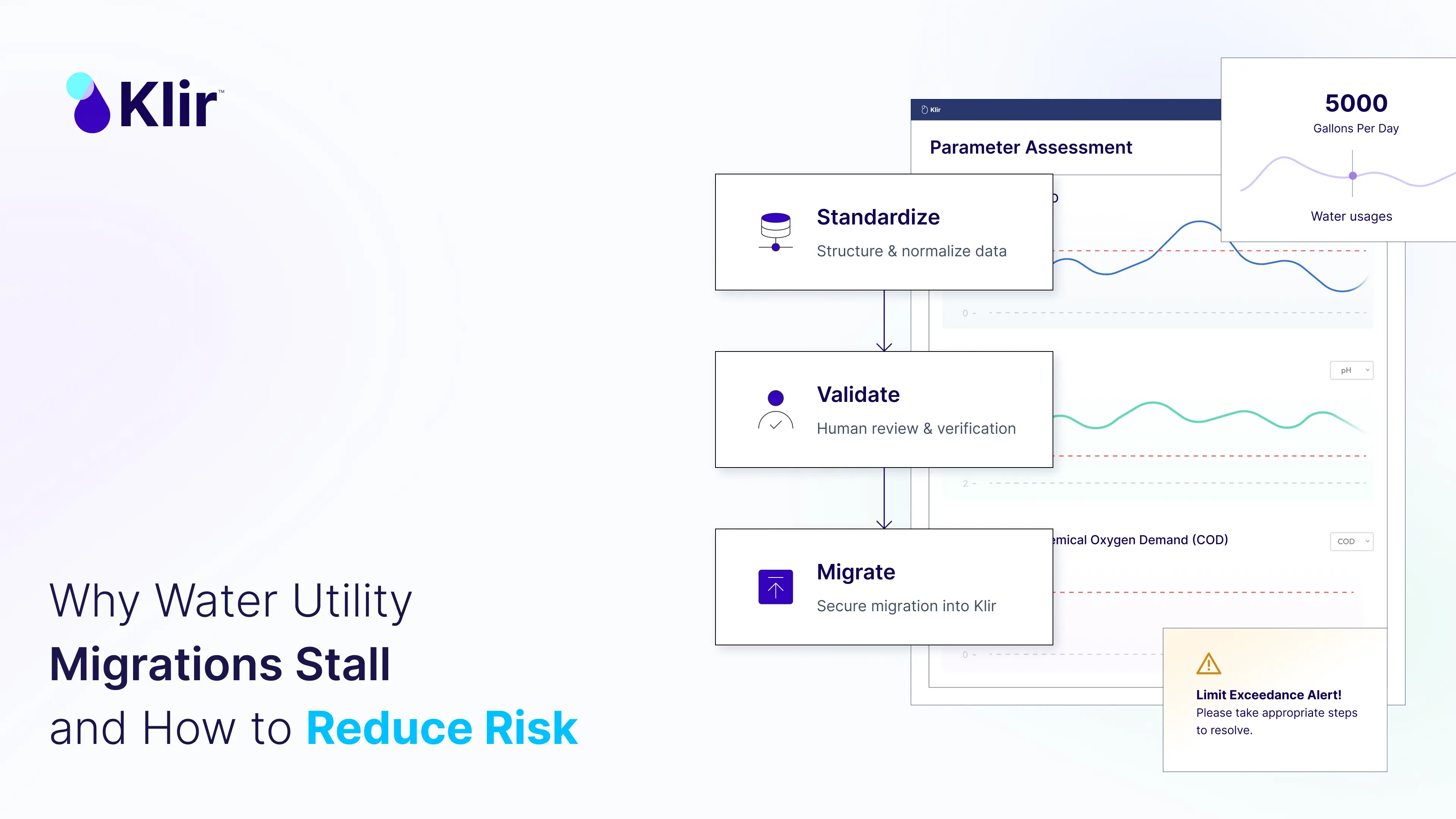
The concept behind Klir’s 24-Hour Data Migration is straightforward.
Rather than relying on extensive manual preparation, Klir uses automated processes to accelerate standardization and validation.
The process consists of three primary stages.
Step 1: Automated Standardization
Incoming datasets are analyzed using algorithms designed to identify:
- Parameters
- Units of measurement
- Analysis methods
- Data structures
The system standardizes records and assigns confidence scores to its recommendations.
Step 2: Human Validation
Automation accelerates the process, but expert oversight remains essential.
Utilities review lower-confidence matches and validate assumptions before migration proceeds.
This ensures data quality while dramatically reducing manual effort.
Step 3: Data Migration
Once validation is complete, data is imported into Klir.
Depending on dataset size and complexity, this process can often be completed within hours rather than weeks.
While a full implementation still requires workflow configuration, user onboarding, and training, the migration phase itself becomes significantly faster.
The Human Side of Successful Implementations
One of the most important themes from the webinar had nothing to do with technology.
It was trust.
Implementation teams often work directly with:
- Pretreatment Coordinators
- Environmental Compliance Officers
- Water Quality Specialists
- Laboratory Managers
- Operations Leaders
These individuals are the day-to-day experts responsible for keeping programs running.
When implementation feels chaotic, confidence declines.
When communication is structured, expectations are clear, and timelines are predictable, adoption becomes significantly easier.
This is one reason why successful implementations depend on more than technology alone.
They require:
- Clear project management
- Defined responsibilities
- Regular communication
- Executive alignment
- Change management planning
The best implementations create confidence throughout the organization—not just within the project team.
What Utility Leaders Should Ask Before Buying Software
Whether you’re evaluating Klir or any other platform, implementation should be a major part of the buying process.
Consider asking vendors:
- What is your average implementation timeline?
- How much data preparation is required from our team?
- Who is responsible for data cleansing?
- How do you handle parameter normalization?
- How do you validate migrated data?
- What implementation resources are included?
- How do you manage executive communication during onboarding?
- What happens if unexpected data challenges emerge?
The answers to these questions often reveal more about project success than a product demo alone.
The Future of Water Utility Modernization
Water utilities continue to face increasing complexity.
Regulatory requirements are expanding.
Data volumes are growing.
Leadership teams need greater visibility into compliance and operations.
At the same time, utility resources remain constrained.
The organizations that modernize successfully will be those that reduce implementation risk, accelerate time-to-value, and build confidence across stakeholders.
Technology plays an important role in that transformation.
But as this webinar highlighted, implementation is where modernization truly begins.
The future of water utility software isn’t just better functionality.
It’s creating implementation experiences that help utilities move faster, reduce risk, and focus on what matters most: delivering safe, reliable water services to their communities.
Ready to Modernize Your Compliance and Operations Programs?
Whether you’re evaluating industrial pretreatment software, wastewater compliance solutions, drinking water management systems, or a broader compliance management platform, implementation should be part of the conversation from day one.
Explore Klir’s platform capabilities, review customer success stories, or schedule a personalized demo to learn how utilities are red



.svg)

%201%20(1).svg)